
 Palmistry
Mar 10, 2026
Palmistry
Mar 10, 2026
How to Learn Palmistry: A Beginner’s Guide
Introduction
Many people are curious about the ancient art of palm reading and often ask how to learn palmistry as a beginner. Palmistry, also known as chiromancy, is the study of the lines, shapes, and features of the hands to understand personality traits and life patterns. This traditional practice has been followed in various cultures for centuries and is closely connected with astrology and spiritual sciences.
Learning palmistry can be an interesting journey for those who want to understand human nature and symbolic patterns. Beginners often start by observing the major lines of the palm, the shape of the hand, and the mounts that represent planetary influences. With patience and regular practice, individuals may develop the ability to interpret these features and gain deeper insights into personality and life tendencies.
Palmistry is generally considered a tool for self-awareness rather than a fixed prediction system. It encourages individuals to reflect on their strengths, challenges, and potential life paths.
What Is Palmistry?
Palmistry is the traditional practice of analyzing the palm to understand certain aspects of a person’s personality, behavior, and possible life patterns. It involves studying the shape of the hand, the length of fingers, and the various lines that appear on the palm.
In many traditional systems, the palm is believed to reflect inner tendencies and experiences. Palmists observe features such as the heart line, head line, life line, and fate line to understand emotional nature, thinking patterns, vitality, and career direction.
For beginners, palmistry begins with learning these basic elements and gradually developing observation skills.
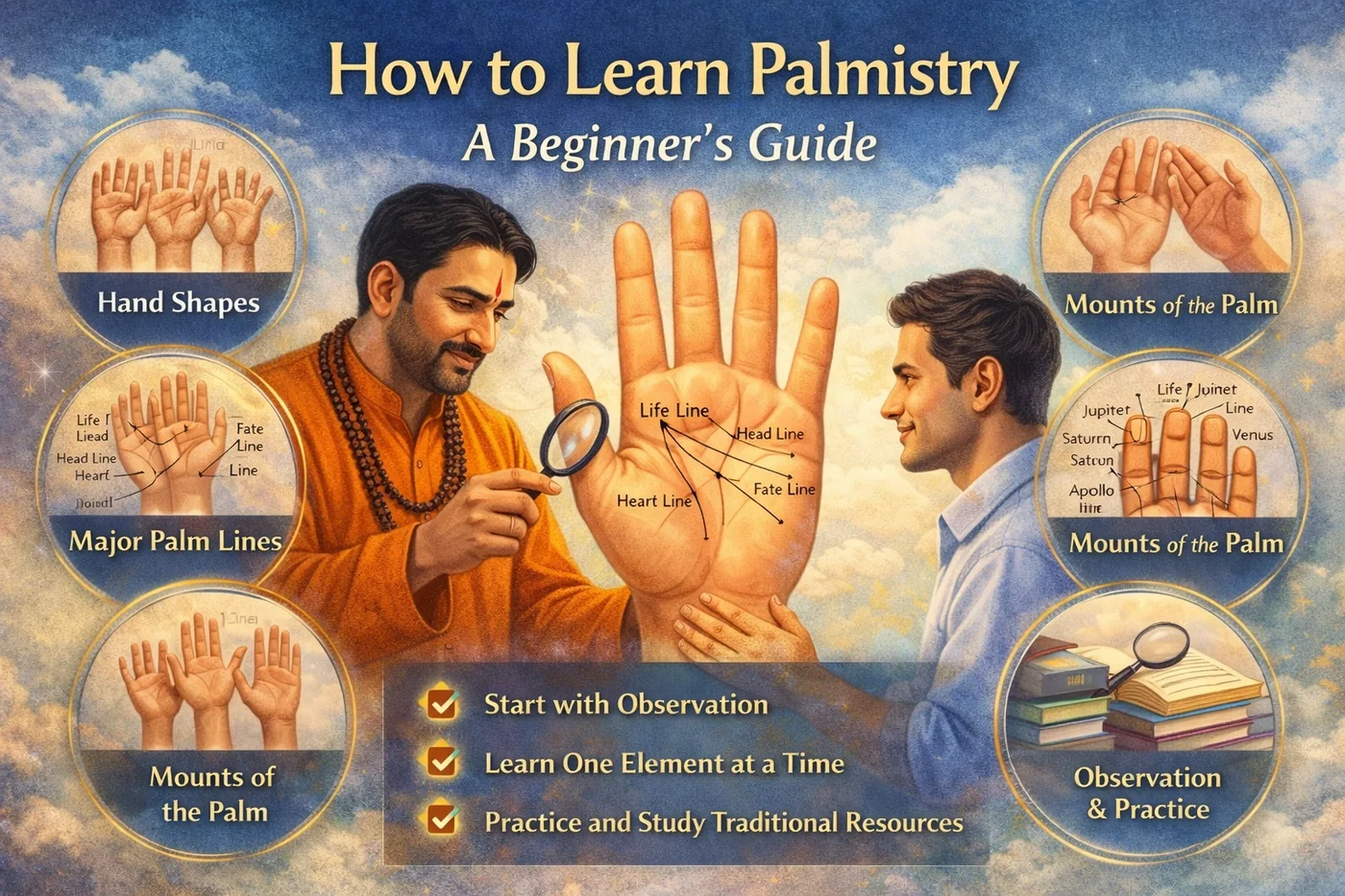
Basic Elements of Palmistry for Beginners
-
Hand Shape
The shape of the hand is often the first thing examined in palmistry. Different hand shapes are associated with different personality characteristics. For example, square hands are sometimes linked with practical thinking, while longer palms may be connected with creativity and intuition.
-
Major Palm Lines
Palmistry beginners usually start by studying the main lines found on the palm.
-
Life Line
The life line curves around the base of the thumb and is traditionally associated with vitality, energy levels, and overall life patterns.
-
Head Line
The head line runs across the middle of the palm and is believed to relate to thinking style, intellect, and decision-making ability.
-
Heart Line
The heart line is located near the top of the palm and is often interpreted as reflecting emotional tendencies, relationships, and feelings.
-
Fate Line
The fate line runs vertically through the palm in some hands and is traditionally associated with career direction and life path.
Mounts of the Palm
In palmistry, the raised areas of the palm are known as mounts. Each mount is associated with a planet and certain qualities.
For Example:
- Mount of Jupiter – leadership and ambition
- Mount of Saturn – discipline and responsibility
- Mount of Apollo – creativity and recognition
- Mount of Mercury – communication and intelligence
- Mount of Venus – love and vitality
Understanding these mounts can help beginners interpret personality traits and natural tendencies.
Tips for Beginners Learning Palmistry
Start with observation. Carefully study the palms of different people to understand variations in lines and hand shapes.
Learn one element at a time. Focus first on the major lines before exploring minor lines and complex patterns.
Use books and traditional resources. Studying classic palmistry texts can help beginners understand interpretations and symbolism.
Practice regularly. Palmistry skills improve through consistent observation and comparison.
Maintain a balanced perspective. Palmistry is often used as a guidance tool for self-reflection rather than a definite prediction system.
Learning Palmistry with Guidance
For beginners who want deeper knowledge, learning from experienced practitioners can be helpful. Astrologers who specialize in palmistry often combine it with astrology, numerology, and spiritual practices to provide broader insights.
Experts like Astro Acharya Pawan guide students and enthusiasts in understanding the foundations of palmistry along with related spiritual sciences. Through traditional knowledge and structured learning, beginners can gradually develop confidence in interpreting palm lines and hand features.
Conclusion
Understanding how to learn palmistry begins with curiosity, observation, and patience. By studying the basic lines, hand shapes, and planetary mounts, beginners can start exploring this ancient system of self-awareness. With regular practice and proper guidance, palmistry can become a meaningful tool for understanding personality traits and life patterns.