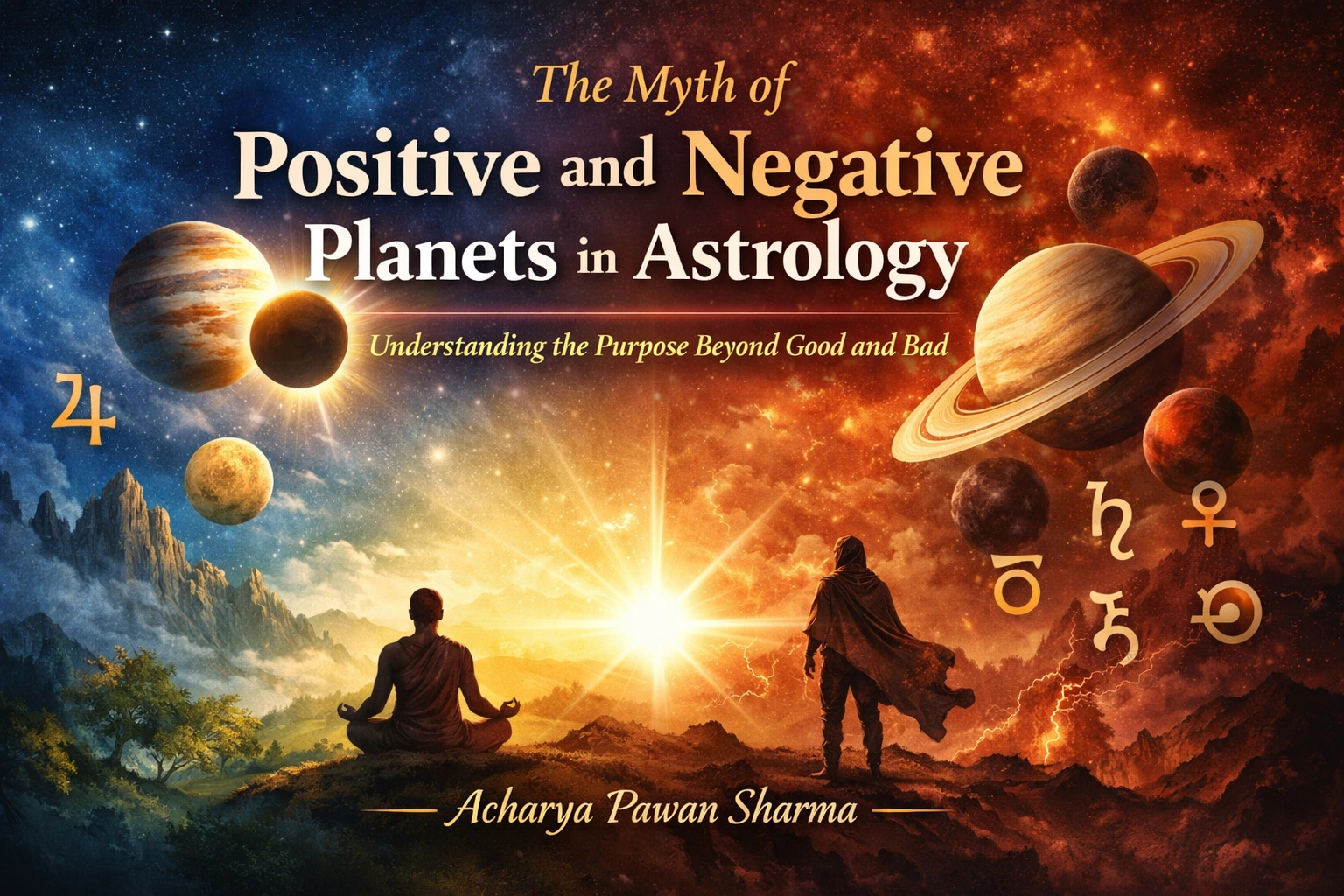
The myth of positive and negative planets in astrology has been widely discussed in both modern and traditional interpretations. Many people believe that certain planets always bring good results, while others are responsible for hardships and struggles. However, this perspective oversimplifies the depth of astrology. In reality, no planet is inherently good or bad—each one serves a unique purpose in shaping our life journey.
In classical astrology, planets like Jupiter and Venus are often labeled as “benefic,” while Saturn, Mars, Rahu, and Ketu are considered “malefic.” This classification has led to a common belief that some planets are naturally positive and others negative.
But astrology is far more nuanced. The effects of any planet depend on its placement, conjunctions, aspects, and the overall strength of the birth chart. A so-called benefic planet in a weak position can create challenges, while a traditionally malefic planet can bring growth, discipline, and success.
Each planet represents a specific energy and lesson:
Even planets associated with comfort and expansion, like Jupiter and Venus, can create imbalance if their energies are not aligned properly.
What we often perceive as “negative” planetary influence is actually an opportunity for growth. Difficult phases in life are not punishments—they are lessons designed to strengthen character and awareness.
For example, a strong Saturn period may bring delays, but it also builds resilience and long-term success. Similarly, Mars-related challenges can teach control over anger and channel energy into productive action.
Astrology is deeply connected with the concept of karma. Planets act as indicators of past actions and future lessons. Rather than labeling them as good or bad, it is more accurate to see them as guides helping us align with our life purpose.
Your birth chart is not a judgment—it is a roadmap. Each planetary placement reflects what you need to learn and experience in this lifetime.
Instead of fearing certain planets, it is important to understand their message. When you shift your mindset from “Why is this happening to me?” to “What is this teaching me?”, astrology becomes a powerful tool for self-growth.
This awareness allows you to work with planetary energies rather than against them.
The myth of positive and negative planets in astrology limits our understanding of this profound science. No planet is here to harm you—each one plays a purposeful role in your journey. By embracing both challenges and blessings, you can unlock deeper insights into your life and move forward with clarity and confidence.
In the end, astrology is not about labeling planets—it is about understanding yourself.



"We envision a future of universal, inherent well-being, achieved by harmonizing the deep knowledge of Vedic Astrology with the advancements of modern medicine to restore Cosmic Natural Health